I'm not a finance person.
I don't have a CFA. I've never worked at a bank. I can't read a balance sheet without Googling at least three things. And yet, for the past two years, I've been designing dashboards for a Swiss P2P lending platform.
Turns out, that's actually fine.
Here's what I learned designing financial products without a finance brain.
You don't need to know everything, you need to know who you're designing for
When I started working with Cashare, I didn't try to learn lending. I tried to learn agents.
What does their day look like? When do they open the dashboard? What are they trying to figure out in the first three seconds? What slows them down? What numbers do they actually use, and what numbers are just noise?
Once I understood the people, the finance part stopped being scary. I wasn't designing "a P2P lending dashboard." I was designing a tool for someone who's on the phone with a client and needs to check one thing fast.
Designers get intimidated by industries they don't know. Don't be. The product is never really about the industry. It's about the human using it.
Ask the dumb questions early
The first time someone said "brokered volume" to me, I nodded like I knew what it meant. I didn't. I went home and Googled it and felt silly.
Don't do that.
Now I ask. "What does this number actually mean? Who looks at it? What do they do with it?" The answers shape the design more than any best-practice article ever will. And honestly, half the time the person explaining it realizes they don't fully know either, which is its own useful information.
The dumb questions are the design questions. Ask them out loud.
Cut the numbers, then cut more
Finance products love to throw data at you. Every metric, every chart, every comparison, every breakdown, all on one screen, in case someone might need it.
That's not a dashboard. That's a panic attack.
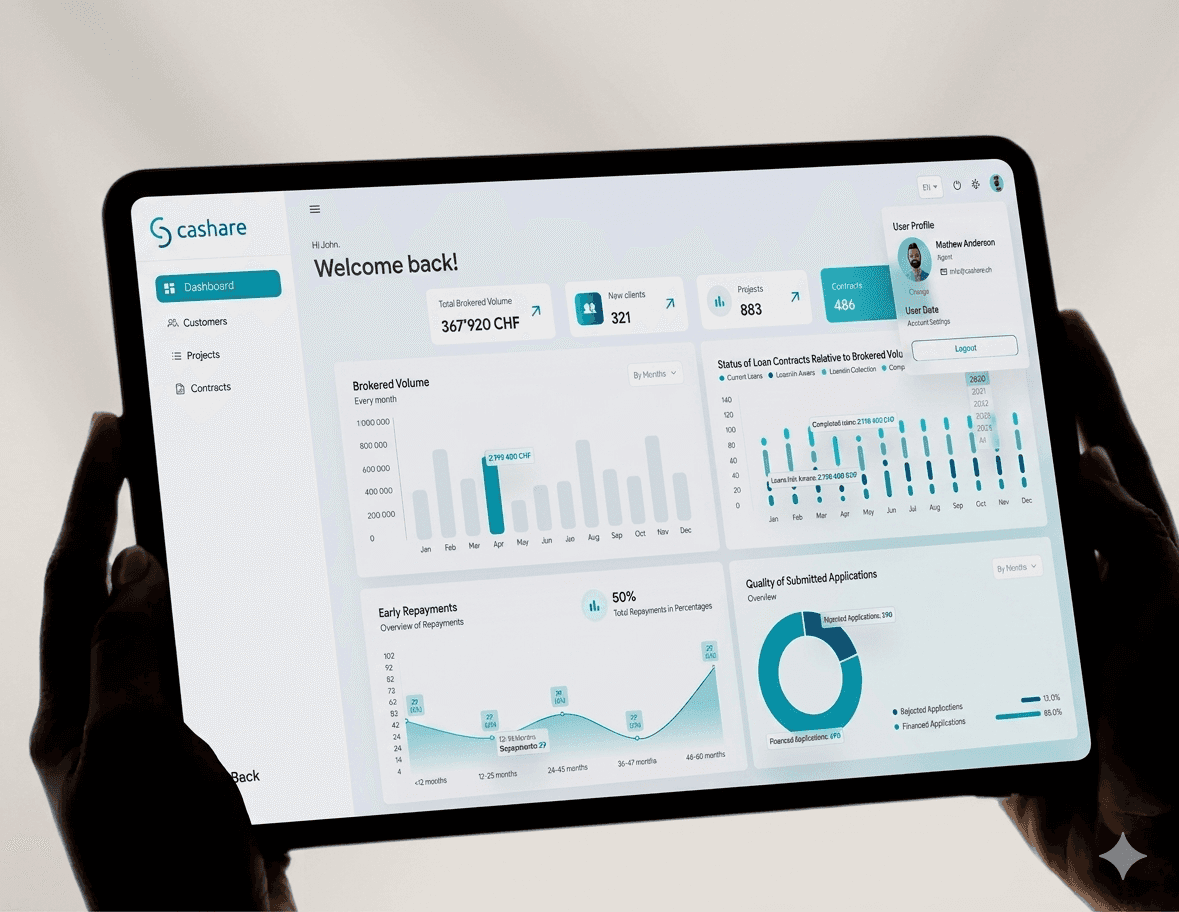
The hardest part of designing the Agent Portal wasn't picking what to show. It was deciding what not to show. I kept asking, "would an agent actually use this in their day?" If the answer was no, it didn't make the cut.
The version that shipped has a fraction of what we could have shown. Agents love it more, not less.
Color is not decoration, it's a guide
When you don't know an industry, you over-decorate. You add gradients to feel polished. You use five colors because the product feels "serious enough" to deserve them.
Don't.
In the Agent Portal, the brand teal only shows up where something is interactive or important. Everything else stays soft. That way, when an agent opens the screen, their eye lands exactly where it needs to. No hunting, no thinking, no decoding what's clickable.
Color is a tool. Use it on purpose, or don't use it.
You're allowed to make finance feel calm
There's a weird unspoken rule that financial products have to look intense. Sharp edges, dense tables, that aggressive "we mean business" energy.
I think that's a leftover from a time when looking complicated meant looking trustworthy. It doesn't anymore.
The agents I designed for were already stressed. The clients on the other end of the phone were already stressed. The last thing anyone needed was a dashboard adding to it.
So I made it calm. Soft backgrounds. Quiet typography. Generous space. Color only where it earns its place. The product still does serious work. It just doesn't shout about it.
You'll learn more than you think
Two years in, I still don't have a CFA. But I can tell you the difference between an installment loan and a bullet loan. I know what a brokered volume chart should answer at a glance. I know which document statuses agents actually care about and which ones are just noise.
I learned all of that by designing, not by studying. By asking, not by pretending. By caring about the people using the product more than the industry the product belonged to.
If you're a designer staring down a finance project and feeling like an imposter, you're not. You just have to start.
Ask the dumb questions. Cut the numbers. Pick one color and use it well. Make it calm.
The finance part figures itself out.
Follow me to keep in touch
Where I share my creative journey, design experiments, and industry thoughts.